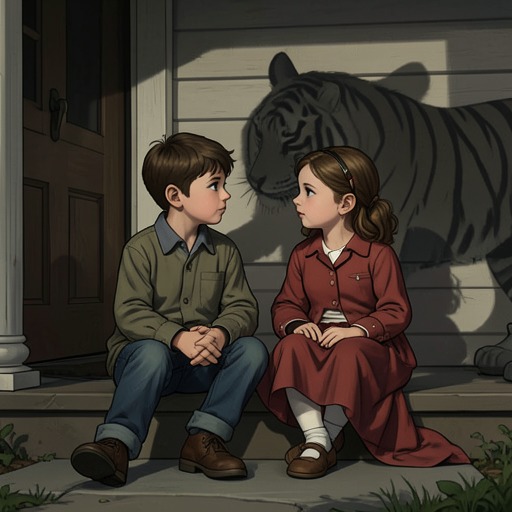
Rob takes Sistine to see the tiger for the first time
The Tiger RisingRob takes Sistine to see the tiger for the first time, transforming a secret he had kept to himself into a shared encounter that also exposes the different meanings they assign to captivity and freedom. Their walk brings Sistine’s family upheaval into the open, prompts Rob to tell her that his mother has died, and ends at the cage with the two children united in concern for the animal but divided over what they can do for him.
The Secret Shared
In the rain, Sistine studies the motel and the blinking Kentucky Star sign as if trying to solve an equation. Rob notices her wet, drooping dress, bleeding knuckles, and dark eyes. Something in him opens; the narration compares the feeling to beginning to shape a piece of wood without knowing what it will become, then watching a recognizable form emerge. He takes a breath and tells her, “I know where there’s a tiger.”
Sistine does not challenge the claim or ask whether he is telling the truth. Her single-word response is “Where?” Rob recognizes that he has chosen the right person to trust. The moment changes their relation: what had been Rob’s guarded knowledge becomes a destination they will approach together. He warns that they will have to walk through the woods, looking doubtfully at her bright dress and shiny black shoes.
The Walk and Their Different Fears
They go together through the scrub after the rain has stopped. The pines, palmettos, and clusters of dead orange trees are still dripping. The landscape provides the route to the tiger, but the walk also becomes a space in which Sistine speaks plainly about her own unsettled life. She says that her mother grew up in Lister and had vowed not to return if she ever escaped. Now her mother is back because Sistine’s father had an affair with his secretary, Bridgette, whom Sistine pointedly says cannot type. Her mother left him, and her father is coming to take Sistine, probably the following week. Sistine insists she will not stay.
Rob responds internally with a loneliness he recognizes. He thinks there is no point in wishing she would remain, and imagines that the suitcase of things he refuses to think about must stay closed. Instead of answering her predicament, he looks at her shiny shoes and tries to will his sadness away. His retreat into silence contrasts with Sistine’s direct declaration of anger and anticipated departure; even while they walk together, Rob expects their companionship to be temporary.
Sistine later stops and demands to know where Rob’s mother is. He first tells her to be quiet and keeps walking, but she refuses to let the question go. When he catches up, he answers in short, ragged gasps: “She’s dead,” followed by, “My mama’s dead.” The disclosure makes explicit the loss behind his silence. Sistine responds with a quick, almost professional nod, steps toward him, and does not interrogate him further. The two turn and walk back in the other direction, toward the tiger. Her acceptance does not undo Rob’s grief, but it gives him company as he carries it into the next encounter.
The Caged Tiger
The tiger remains in the same enclosure Rob has seen before: rusted chain-link fencing, a wooden board for a roof, and a chain-link door secured by three padlocks. Inside, the tiger paces back and forth as if the movement has never stopped, or as if Rob has never been away. The repeated pacing makes the cage feel like a condition continuing beyond any single visit; the tiger’s confinement is present before either child proposes what should be done about it.
Sistine calls the tiger beautiful, speaking in the same tone she used when she saw Rob’s carvings. Rob warns her not to get too close, since the tiger might not like it. Their first responses establish distinct forms of attention: Sistine openly admires the animal, while Rob’s familiarity with the enclosure leads him to caution. The tiger is not merely the secret that brought them together; his living presence draws both children into a moral disagreement about their responsibilities.
Freedom and the Limits of Permission
Sistine argues that it is wrong for the tiger to be in a cage and proposes setting him free. Rob says they cannot do anything about it. When she insists that they have to release him, he objects that it is not their tiger to let go. Sistine answers fiercely that it is their tiger to save. The exchange shifts their shared visit from looking at the animal to disputing what care requires: Rob treats ownership and authority as limits, while Sistine frames the tiger’s captivity as an urgent claim on them.
The tiger stops pacing and moves his ears back and forth, looking somewhere beyond the children. Rob tells Sistine to be quiet. The encounter therefore ends not with a release but with the disagreement unresolved, the animal still locked behind three padlocks. Yet the visit establishes the conflict that will shape their later choices: Rob has trusted Sistine with the tiger’s location and with his mother’s death, while Sistine presses him to turn concern into action. Their first meeting at the cage binds friendship to a question neither can dismiss: whether recognizing another being’s confinement also obliges them to intervene.